Call for Applications
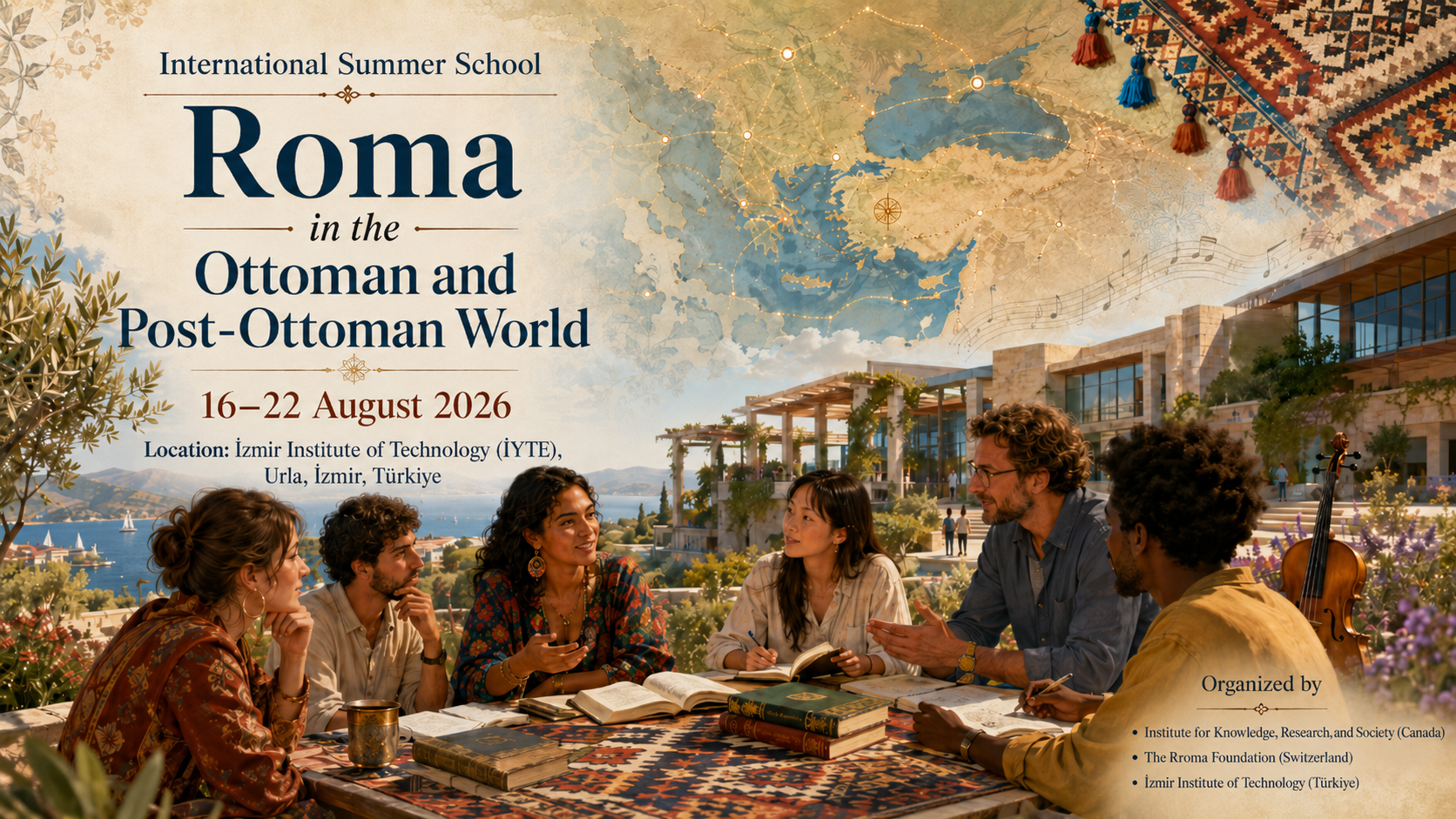
International Summer School
Roma in the Ottoman and Post-Ottoman World
16 -22 of August 2026
Location: İzmir Institute of Technology (İYTE), Urla, İzmir, Türkiye
Organized by
Institute for Knowledge, Research, and Society (Canada)
The Rroma Foundation (Switzerland)
İzmir Institute of Technology (Türkiye)
Application Deadline: 15 July 2026
Key Information
👥 Approximately 20 participants
💰 No participation fee
🛏 Accommodation provided
🍽 Meals included
For detailed information, please scroll down.
For questions: contact@ikrs.org
Apply now!
Applications are open until July 15, 2026
The Summer School Concept
The Ottoman Empire and the post-Ottoman world constitute one of the most historically and culturally diverse regions of Europe (including contemporary territories of Moldova and partially Ukraine), the Balkans, Anatolia, and the Eastern Mediterranean. Although the Ottoman Empire disappeared more than a century ago, many of the political, social, cultural, and demographic processes that emerged during the imperial period continue to shape societies, identities, and intercommunal relations across the region today. Understanding the post-Ottoman world, therefore, requires looking beyond present-day state borders and considering the shared historical experiences that continue to connect these societies.
Throughout history, imperial and post-imperial settings have profoundly influenced the lives of minority communities. The experiences of migration, settlement, coexistence, social inclusion and exclusion, citizenship, discrimination, persecution, and cultural exchange have unfolded differently across successive political regimes while remaining embedded within broader historical continuities.
This Summer School focuses on the Roma, who are one of the most geographically widespread minority populations of the Ottoman and post-Ottoman world. Their history encompasses a remarkable diversity of communities, languages, religions, occupations, cultural traditions, and historical experiences extending from Anatolia and the Balkans to Eastern Europe and beyond. Yet this diversity has often remained fragmented within national historiographies and disciplinary boundaries.
The International Summer School “Roma in the Ottoman and Post-Ottoman World” brings together various perspectives within a single interdisciplinary framework for the first time in the international setting of Romani Studies and Imperial Studies. Combining history, social anthropology, sociology, urban studies, political science, memory studies, and cultural studies, the program explores the historical trajectories, contemporary realities, and future challenges of Romani communities across this interconnected region. Cooperating with the Urla and Izmir Romani communities, the Summer School addresses not only the history and culture of Romani communities in the region but also antigypsyism and contemporary survival challenges.
Why Urla?
Located on the Aegean coast of Türkiye, Urla provides an exceptional setting for an international Summer School combining academic learning with cultural and historical exploration. The İzmir Institute of Technology (İYTE), situated on a spacious and modern campus overlooking the Aegean landscape, offers an ideal environment for intensive study, discussion, and international exchange.
Urla and the surrounding İzmir region are home to vibrant Romani communities whose historical presence continues to shape the region’s social and cultural life. The Summer School, therefore, offers participants not only academic perspectives but also opportunities to engage directly with local communities through workshops, cultural activities, and dialogue, connecting scholarly discussions with contemporary lived experiences.
The nearby İzmir is Türkiye’s third-largest city that has been for centuries one of the Eastern Mediterranean’s principal centers of culture, commerce, and coexistence, sharing space with Turks, Greeks, Roma, Jews, and others. The wider Aegean region reflects successive layers of ancient, Byzantine, Ottoman, and modern history, offering participants an opportunity to experience one of the most historically interconnected regions of Europe and the Middle East. The proximity of internationally renowned historical sites, including Ephesus, further enriches the educational experience by situating discussions of history, mobility, and cultural interaction within their broader historical landscape.
Programme Format and Academic Committee
The Summer School is organized as a seven-day program, including one arrival day, five intensive academic days, and one departure day. The academic program combines lectures, seminars, roundtable discussions, community-based learning, practical workshops, and guided cultural activities. Participants will explore the history, societies, cultures, and contemporary realities of Romani communities across the Ottoman and post-Ottoman world through an interdisciplinary perspective that brings together history, anthropology, sociology, political science, communication studies, memory studies, cultural studies, and related fields.
The program covers a broad geographical area extending from Anatolia and Türkiye to the Balkans, Romania, Moldova, Ukraine, and other regions historically connected through the Ottoman and post-Ottoman experience. Particular attention will be devoted to historical diversity, language, identity, mobility, memory, persecution, the genocide of Roma and Sinti during the Second World War, cultural heritage, minority rights, public policy, and contemporary challenges facing Romani communities.
In addition to academic lectures, participants will take part in community-based workshops led jointly by scholars and members of Romani communities in the Urla region. These activities include traditional Romani music and weaving workshops, offering participants the opportunity to experience cultural traditions while engaging directly with local knowledge holders. The program emphasizes dialogue and cooperation between Romani and non-Romani participants, lecturers, artists, and community members, creating a collaborative learning environment that bridges academic research and lived experience.
The working language of the Summer School is English. Interpretation will be provided during community workshops conducted in Romanes and Turkish, ensuring that all participants can engage in the program.
Academic Committee
The Academic Committee is responsible for the Summer School’s academic development, participant selection, and the overall quality of the program.
- Dr. Hanna Abakunova, Tompkins Visiting Professor in History and Cultural Studies, University of Alberta (Canada), and affiliated researcher at the Institute for Russian and Eurasian Studies, Uppsala University (Sweden). She is a historian and interdisciplinary scholar working on Eastern Europe’s interethnic relations, history, and memory, with a particular focus on Roma and Jewish communities. She is a founder and co-organizer of the Monthly International Interdisciplinary Seminar Series in Romani Studies.
- Dr. Stéphane Laederich, Director of the Rroma Foundation (Zurich, Switzerland). He is a specialist in the Romani language and dialects, the author of textbooks in several Romani dialects, and co-author of The Rroma, a comprehensive work on Romani history, ethnography, and linguistics. He also co-organizes the Monthly International Interdisciplinary Seminar Series in Romani Studies.
- Dr. Hüseyin Oylupınar,Institute for Knowledge, Research, and Society (Canada) and affiliated researcher at the Institute for Russian and Eurasian Studies, Uppsala University (Sweden). He is a historian and interdisciplinary scholar working on Eastern Europe, the Black Sea region, the North Caucasus, empire, memory, minority politics, and post-imperial transformations, and the author of The Politics of Roma Memory in Moldova.
- Dr. Ozan Uştuk, İzmir Institute of Technology (Türkiye). He is a scholar of communication studies and anthropology whose ethnographic research focuses on Romani communities in Türkiye, including housing, education, labour market relations, intercultural communication, cultural identity, and urban ethnography. Since 2014, he has collaborated with local and national Roma organizations, civil society organizations, and public institutions.
Why to Apply?
The International Summer School offers participants a unique opportunity to explore the history, cultures, and contemporary realities of Romani communities through an interdisciplinary and comparative perspective that places the Ottoman and post-Ottoman world at the center of inquiry. Participants will learn from internationally recognized scholars and experts while also engaging directly with Romani community members through workshops, cultural activities, and discussions. By combining academic study with community-based learning, the program creates an environment that encourages critical thinking, intercultural dialogue, and international collaboration.
Participants will gain a comprehensive interdisciplinary understanding of the history, diversity, and contemporary realities of Romani communities across the Ottoman and post-Ottoman world. Through lectures, seminars, workshops, and community engagement, the program aims to strengthen both subject-specific knowledge and broader analytical perspectives relevant to the study of minority communities, empires, and post-imperial societies.
Upon successful completion of the Summer School, participants will have:
- gained a deeper understanding of the historical development and diversity of Romani communities across the Ottoman and post-Ottoman world, including Türkiye, Greece, the Balkans, Moldova, Crimea, and southern Ukraine
- developed comparative perspectives on empire, post-imperial transformation, minority experiences, identity formation, and cultural diversity;
- become familiar with major scholarly debates, methodologies, and current research in Romani Studies and related disciplines;
- strengthened their ability to analyze issues relating to discrimination, persecution, the genocide of Roma and Sinti, memory, cultural heritage, minority rights, and contemporary public policy;
- explored interdisciplinary approaches combining history, anthropology, sociology, political science, communication studies, cultural studies, memory studies, and related fields;
- gained first-hand experience of community-engaged research and intercultural dialogue through direct interaction with Romani communities in the İzmir region;
- established international academic and professional networks with participants, lecturers, and community representatives from different countries and disciplinary backgrounds.
Participants who successfully complete the program will receive an official Certificate of Participation issued upon completion of the Summer School.
Who Should Apply?
The Summer School is designed for individuals with a genuine academic or professional interest in the history, society, culture, languages, memory, antigypsyism, and contemporary challenges of Romani communities. We welcome applications from participants representing diverse disciplinary backgrounds, nationalities, cultures, and career stages.
Applications are welcome from:
- undergraduate and graduate students;
- doctoral and postdoctoral researchers;
- university faculty;
- school teachers and educators;
- museum, archive, library, and cultural heritage professionals;
- cultural workers;
- independent scholars and researchers;
- professionals whose work relates to the Summer School’s themes.
Applicants from disciplines including history, anthropology, sociology, political science, communication studies, cultural studies, linguistics, education, law, geography, archaeology, heritage studies, and other related fields are encouraged to apply.
The program welcomes applications from participants of all nationalities and citizenships. Applications from individuals of Romani origin are particularly welcome, and the Summer School seeks to create an inclusive academic environment in which Romani and non-Romani participants learn, exchange perspectives, and contribute equally to discussions.
What We Offer
There is no participation fee for selected participants. The organizers will provide the following throughout the Summer School:
Academic Program
- Full participation in the seven-day interdisciplinary academic program.
- Lectures, seminars, discussions, and workshops led by an international team of scholars and experts.
- Community-based workshops conducted jointly by academics and members of local Romani communities.
- An official Certificate of Participation upon successful completion of the program.
Accommodation and Meals
- Accommodation and Meals
- Accommodation in comfortable three- or four-person rooms with private bathroom facilities at the İzmir Institute of Technology campus.
- Meals and coffee breaks throughout the program, according to the official schedule.
- Participants will stay on the campus of the İzmir Institute of Technology in comfortable shared rooms with private bathroom facilities within a 10-minute walk to the auditorium, cafeteria, and bus stops to the Urla city center. Additional practical information regarding accommodation, meals, campus services, and local transportation will be sent to all selected participants after admission.
Cultural Programme
Participants will also take part in a series of cultural and community activities, including:
- traditional Romani weaving workshop;
- traditional Romani music workshop;
- visit to a Romani community organization in İzmir;
- guided tours to Urla old town and İzmir historical center;
- opportunities to engage directly with members of local Romani communities.
Local Transportation
The organizers will provide:
- airport transfers between İzmir Adnan Menderes Airport and the İYTE campus on the official arrival and departure days;
- local transportation required for all academic and cultural activities included in the program.
Free Time
The program also includes free time, allowing participants to enjoy Urla’s Aegean coastline, beaches, cafés, and historic town center, as well as to interact informally with fellow participants and lecturers.
Due to limited funding, Participants are responsible for arranging and covering the following costs themselves:
- international and domestic travel to and from İzmir;
- health insurance valid for the duration of their stay in Türkiye if applicable;
- visa-related costs, where applicable;
- personal expenses during free time, including tickets to the sites of interest;
- additional meals, snacks, or drinks outside the official program schedule;
- optional personal travel before or after the Summer School.
Participants who wish to request an upgraded room, such as a two-person or single room, may do so (subject to availability) at their own additional expense. The estimated additional cost for upgraded accommodation is approximately 25–40 EUR per day, depending on room type and availability.
Visa Requirements
Citizens of many European and North American countries may enter Türkiye without a visa or are eligible to obtain an electronic visa (e-Visa). As visa regulations vary by nationality, applicants are encouraged to verify the entry requirements applicable to their country before making travel arrangements.
Official invitation letters will be provided to all selected participants who require them for visa applications or institutional purposes.
Arrival
The nearest international airport is İzmir Adnan Menderes Airport (ADB). Airport transportation between the airport and the İzmir Institute of Technology campus will be provided on the official arrival and departure days.
Language
The working language of the Summer School is English. Interpretation will be provided during community workshops conducted in Romanes and Turkish. English is widely used at universities, hotels, airports, and many tourism-related services in İzmir and Urla, making it possible for international participants to communicate comfortably throughout their stay.
Climate
Summer is the hottest season on the Aegean coast. All facilities and transportation are equipped with air conditioners. Participants are advised to bring light summer clothing, comfortable walking shoes, swimwear, sun protection, and reusable water bottles.
Expectations from Participants
The International Summer School is designed as an intensive academic program that emphasizes active participation, interdisciplinary dialogue, and mutual learning. Participants are expected to contribute to creating a respectful, collaborative, and intellectually engaging environment throughout the program.
Selected participants are expected to:
- attend the full seven-day program, including the arrival and departure days;
- participate actively in lectures, seminars, workshops, discussions, and cultural activities;
- engage respectfully with fellow participants, lecturers, workshop leaders, and members of local Romani communities;
- contribute constructively to discussions by sharing perspectives, experiences, and disciplinary approaches;
- comply with the academic schedule and the program’s code of conduct.
Participants should be prepared for an intensive program that combines classroom-based learning with community engagement, cultural activities, and field visits. As the Summer School brings together participants from diverse academic, cultural, and national backgrounds, openness to dialogue, intercultural understanding, and respect for different perspectives are considered essential components of the learning experience.
Application Package, Selection Procedure, and Selection Criteria
Applications must be submitted through the online application form no later than 23.59 CET on the 15th of July 2026.
The following documents are required:
- Completed online application form
- Motivation Statement, including current Research, Professional, or Community Interest (maximum 500 words)
- Curriculum Vitae (maximum two pages)
Selection Criteria and Procedure
Applications will be evaluated by the Academic Committee. The selection process aims to create an academically strong, internationally diverse, and interdisciplinary group of participants representing different countries, institutions, disciplines, and professional backgrounds.
Applications will be evaluated based on:
- Relevance of the applicant’s academic, professional, or personal interests to the themes of the Summer School;
- quality and originality of the motivation statement;
- potential to contribute actively to discussions and the interdisciplinary learning environment;
- diversity of academic disciplines, geographical representation, and professional backgrounds;
- overall balance of the participant cohort, including gender.
Applicants will be informed of the outcome of the selection process no later than 20 July 2026.
Diversity Statement
The International Summer School is committed to fostering an inclusive, respectful, and intellectually open learning environment. Applications are welcomed from individuals of all nationalities, citizenships, ethnic and cultural backgrounds, genders, religions or beliefs, ages, and disciplinary traditions.
The program particularly encourages applications from individuals of Romani origin, while welcoming both Romani and non-Romani participants who share a genuine academic interest in the themes of the Summer School. Participant selection is based solely on the quality of the application, its relevance to the objectives of the program, and the Academic Committee’s aim of creating a diverse and balanced international cohort.
Apply
Applications must be submitted through the online application form no later than 15 July 2026.
Online Application Form:
Applicants are encouraged to prepare all required application materials before completing the online form.
For questions regarding the application process or the summer school, please contact:
Email: contact@ikrs.org
Website: Call for Applications – Institute for Knowledge, Research, and Society
About the Organizers
Institute for Knowledge, Research, and Society (IKRS), Canada
The Institute for Knowledge, Research, and Society (IKRS) is an independent Canadian research institute dedicated to advancing interdisciplinary scholarship, international academic cooperation, and public engagement. Its activities focus on history, memory studies, minority communities, Eastern Europe, the Black Sea region, and the North Caucasus, while fostering collaborative research, education, and knowledge exchange across institutional and national boundaries.
Website: ikrs.org
The Rroma Foundation, Switzerland
The Rroma Foundation, based in Zurich, Switzerland, is an international non-profit organization dedicated to the preservation, promotion, and teaching of the Romani language, history, and culture. Through research, publications, educational initiatives, and international cooperation, the Foundation works to strengthen Romani cultural heritage and support the development of Romani Studies worldwide.
Website: Rroma Foundation
İzmir Institute of Technology (İYTE), Türkiye
The İzmir Institute of Technology (İYTE) is one of Türkiye’s leading public research universities, recognized for its strong emphasis on scientific excellence, internationalization, and interdisciplinary research. Located in Urla on the Aegean coast, the university provides a modern campus environment and serves as an important center for international academic collaboration.
Website: İYTE